

Travelling is not all people make it out to be, he thinks. Having a place where one can feel truly at home is so much better. But he, having travelled so long and so often, has no such place in the world.
He spends the afternoon on the ship’s deck, under a strange, waning light that makes the sea appear sickened and yellow. He pays his fellow passengers no mind even as he tips his hat out of habit, acknowledging their presence, but looking away before he can be mistaken for seeking conversation. He thinks of his lovely Marianne, left behind. How beautiful, how brave. How she wished she could accompany him on this voyage—he did, too, but of course knew such a thing to be impossible.
After the sun sets, he finally retreats to his cabin. He’s surprised to find he already thinks of it as his, even though he’s only inhabited it for a few days. It is small, wooden, the bed narrow and clad in red, which he appreciates; one can always find some comfort in things unapologetically red. He lies on it without getting out of his clothes. Marianne’s arm lies quietly next to him. When her hand cups his cheek gently as he rests his head on the foreign pillow, he thinks, now this, maybe this, one day, can feel like home.
• • •
He wakes up with the arm nestling next to his body like a cat. He’s surprised the arm retains a certain warmth; he’s no student of the medical sciences, but he’d have expected a severed limb to be cold, no matter how preternaturally alive. The discrepancy pleases him; after all, he’s always been proud of his capacity to be happy about being proven wrong. He orders breakfast to be delivered to his cabin and, as he sits there at his small table with tea and toast laid out in front of him, he intertwines his fingers with Marianne’s and imagines the rest of her sitting by his side. He banishes the last images he has of her: the reddened nose, the tear-streaked cheeks, her other arm holding the bloodied hatchet. He’d rather remember her lovelier than she was the day of his departure, despite how grateful he is for her willing sacrifice.
He spends the day in his cabin, lost in his thoughts of Marianne and the arm that now accompanies him. He can’t help but wonder what it would be like to have the rest of her with him, wrapped in his own arms. In his mind, he runs his fingers through her hair, imagining it to be silky and smooth—already, he can hardly remember what her real hair was like. He admires her lips, how soft and plump they were. Her scent, he thinks, would linger in the room, which might not be entirely welcome. He always found the perfume she used too sweet, almost nauseating. If he’s honest, he prefers the earthy pinewood scent of the cabin without her in it, the salty sea air that makes everything feel dried out and sterile. Still, he marvels at the intricacy of the limb, the way the fingers curl and flex at his touch. He imagines that, somehow, Marianne’s essence still flows through the arm; that, really, the arm is no different than Marianne herself, and that this particular part can truly stand in for the whole. In some ways, it’s better that the rest of her was unable to follow him on this journey. It is, after all, a very small cabin.
When night falls, he lies on the bed again and lays the arm on top of his chest. He tells it of his destination and finds himself sharing details he’s never spoken before, things he would never have told Marianne herself—or the rest of her, in any case. He had painted this voyage as compulsory and unavoidable, which it isn’t, just as Marianne’s following him wasn’t impossible—not in the strictest of terms. His employer had secured him lodgings that could have housed Marianne, too, and his salary was large enough to cover both their expenses, if they were willing to be a little frugal. He had left those details out, though; he had so meticulously obscured them, in fact, that sometimes he, too, forgot about them. But the truth is he’d simply seen an opportunity to start over alone; alone, he’d taken it.
As he speaks to the arm, he feels the weight of his secrets lifting off his shoulders. He confesses to the arm his doubts of ever having truly loved Marianne. He tells the arm about his hopes of finding someone else on this voyage, someone who could make him forget about Marianne and his old life in his previous home altogether.
The arm remains unmoved, but he imagines it listens to him intently, with an understanding of his deepest fears and desires. Marianne proved to be a selfless, devoted woman. He had courted her doggedly not because he’d needed to, but because he never did anything half-heartedly. Marianne had given herself to him so completely that his pursuit seemed overeager, even squandered, in retrospect. But now he feels vindicated. With her arm by his side, he is less alone, less lost in the vastness of the sea.
• • •
In the morning, he leaves the arm in his cabin and goes to the ship’s deck having skipped breakfast. He inhales the salty sea air, lets the wind clear his head of the confessions he made to the arm the night before. On a ship, he thinks, in the middle of the sea, on a voyage to a new country accompanied by no one you know, one can truly feel like a new man.
While he’s lost in thought, another man comes to stand next to him. He’s younger, with brighter eyes and, he must admit, as good-looking as he wishes he’d once been. The young man is wearing a green velvet vest; he has the overwhelming urge to reach out and touch it. The young man nods in greeting, and he nods back but quickly looks away, embarrassed. Thankfully, a dazzling young woman trots up to them then and tears the young man from the balustrade. Quickly, the two of them disappear back into the inside of the ship.
• • •
He meets the young man again at dinner, as their tables happen to be side by side, and he is surprised to discover the young man is accompanied not by the dazzling woman he saw in the morning, but by another one, equally beautiful. The young lady chatters away as the waiters bring them covered plates of steamed fish and slices of lemon so thin you can see through them.
He picks at his fish without gusto, stealing glances at the couple. He imagines Marianne here; how out of place she would look, how pale and dreary compared to these fanciful youths. He’s more certain than ever that leaving Marianne behind was the right decision. Still, when he returns to his cabin, he finds solace in the arm’s soft touch. He lies on his bed and, as has been his new habit, lets the arm slither close, its fingers nibbling at the loose folds of skin on his neck. In this way, before he knows it, he falls asleep.
• • •
In the morning, he doesn’t forgo breakfast this time, hoping to run into the young man again. And so he does; in fact, the young man appears dressed in his usual green velvet vest, a newspaper (where on earth did he get a newspaper, out here at sea?) folded neatly under his arm, introduces himself as Victor, and asks if he may join the man for breakfast. The man tries to hide the swell of joy in his chest as he politely inclines his head.
“Will your pretty companion be joining us?” he asks, and Victor laughs.
“Which one?” he asks back, winking.
He feels himself blush. “Oh, well,” he says, fumbling for words, but the young man laughs again and pats him too familiarly on the shoulder.
“I’m known to make friends wherever I go,” Victor says, settling himself down and signalling the waiter for coffee. “And there seems to be no scarcity of young women to make friends with.” The man expects another wink, but the youth this time appears to be talking earnestly. Victor lays his napkin on his lap with a flourish. “Why settle for less?”
He would normally find such demonstrations of philandering crass, or at the very least annoying, but he has to admit that the young man is rather charming. He has a childish way about him, which makes behaviour that would otherwise be obnoxious seem playful and innocent.
“But enough about me,” Victor says. “How about yourself? Are you alone on this journey?”
The waiter approaches to set a pot of coffee in front of them then, giving the man time that he finds himself in desperate need of in order to formulate an answer. Still, he stammers. “Yes,” he says after the waiter retreats again, and then, “I mean, no. Not quite.” The waiter comes back with a plate of toast and jam.
Victor laughs an easy laugh again. “So which is it? Yes, or no?” He quirks his eyebrow and tilts his head, which makes him seem even younger than he must be. A dimple appears audaciously in his smooth cheek. “It can hardly be that complicated.”
“My fiancée’s arm is with me,” the man says. “It’s in my cabin. I suppose I have not been keen to be seen with it in public. Though there is, of course, no shame in it.”
The young man’s face drops. “Oh,” he says. “Oh I see. I’ve heard of such cases before.” He takes a sip of coffee and then proceeds to spread jam on his toast. “How unfortunate.”
“Is it?” he asks. He finds Victor’s pity interesting. He thinks, if he can’t have the man’s admiration, pity is good enough.
“A man ought to enjoy himself in public,” Victor says, chewing daintily. “Don’t you think?”
He ponders this. He’s always felt himself bound by obligation. He’d never before entertained the thought that enjoyment could form part of a man’s obligations. “I suppose,” he says. He bites into his own toast, and finds the jam too sweet for his taste.
“Perhaps, later,” Victor says, “you can introduce me.”
It’s his turn to laugh. Can one really introduce somebody to an arm? But he finds himself agreeing nonetheless, even looking forward to it.
• • •
He spends the day in Victor’s company. They sit on the deck under the brief sun with one of Victor’s young suitors, then lunch with another, and have tea with a third. He has a splendid time, yet finds himself fidgety with anticipation, knowing that, before dinner, he shall bring Victor to his cabin and show him Marianne’s arm.
As they walk towards his cabin, his heart beats fast, and blood pumps in his ears. He wonders whether Victor will find the arm grotesque or fascinating. Will he deem it clinging? Will he judge this desperate holding on?
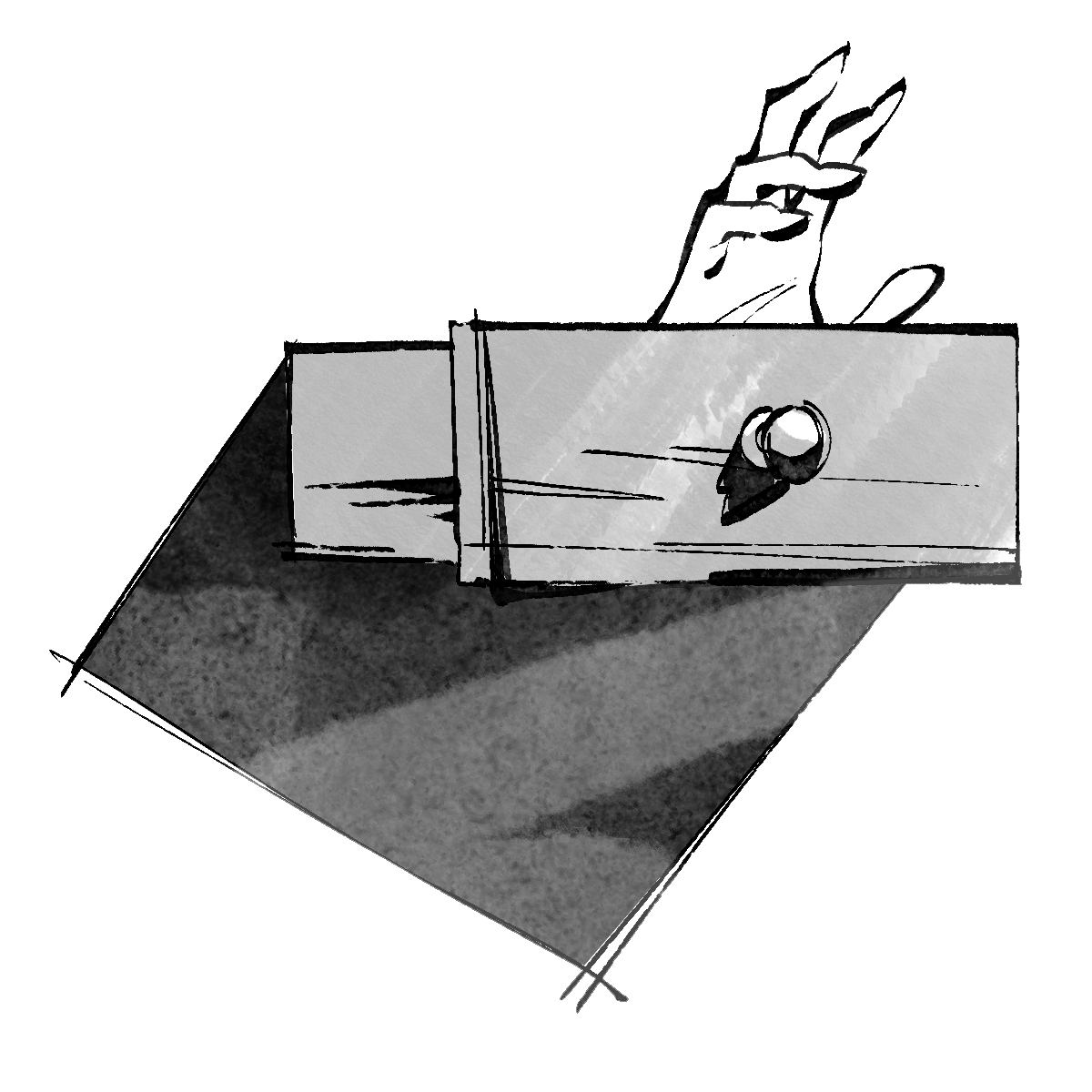
When they enter the cabin, the man immediately opens the drawer where he placed Marianne’s arm. He doesn’t know why he chose to put it in a drawer this time, when every other day he’d left it nestled on top of his bed blankets. Had he started growing uneasy about the arm, without realizing, and expressed it without thinking? Perhaps. Now, the arm lies there, pale and warmer than it looks, with the delicate fingers slightly curled. He takes a deep breath and turns to Victor.
To his relief, the young man doesn’t look repulsed. Instead, he walks towards them, eyes fixed on the arm, the expression on his face harder to read than the man would like.
“May I?” Victor asks, and the man simply nods. Ought he to feel some kind of possessiveness over the arm, as if the young man just asked to put his fingers on his fiancée? Again, perhaps. Still, he steps back to let Victor examine the arm to his satisfaction.
Victor picks up the arm gently, turns it over, studies it from the tips of its fingers to the fraying end where it used to connect with the curve of Marianne’s shoulder. He traces the faint lines of the veins, his own fingers barely touching the arm’s skin.
“Fascinating,” Victor says, though he doesn’t quite sound fascinated. “And heavier than it looks.” Then, he meets the man’s gaze and asks: “Are you ever scared of it?”
He’s startled by the question, and he just barely stops himself from taking a step back, as if to narrowly avoid a blow to the face. “Scared of it? What would I be scared of? It’s just an arm—no, more than that, the arm of a woman who loved me desperately.” He notices the past tense too late.
“Of course,” Victor replies placatingly. “Still, don’t you ever wonder what it does while you sleep? Or, worse, if it has thoughts? What it thinks of you?”
“No, never,” he says, but then he thinks maybe he ought to have had thoughts such as these. Why hasn’t he? Desperation can, after all, breed regret. Regret can beget vengefulness. Why hasn’t he?
• • •
These thoughts torment him through the night, and his sleep is fitful, which by morning has put him in a foul mood. The arm is still on the nightstand beside him, lying inert, and he stares at it with unease, Victor’s words from the night before having left a bitter residue on his tongue. Might there be some truth to them?
Perhaps it is his foul mood, or the words acting as a self-fulfilling prophecy, that causes the accident—because he does think of it as an accident at first: he reaches out to retrieve a glass of water from the nightstand, but hesitates at the last moment, afraid that the arm might grip his hand. For the first time, he shudders at the thought of that skin touching his. He shakes his head, chiding himself for such foolish ideas. It’s just an arm, he reminds himself, nothing more. It is Marianne’s arm. Still, he abandons the thought of the glass of water and stands up to wash his face and take a drink from the tap instead. As he passes the nightstand, the arm moves; it grasps his shirt, making him stumble. He loses his balance, falls; his head knocks against the sink. He loses consciousness.
When he comes to, the arm is still on the nightstand. Staring at him, he thinks, though of course such a thing is impossible for something that lacks eyes. He pulls himself to his feet and examines his face in the mirror. Mere moments have passed—anything longer would surely mean his injury is life-threatening, which he’s certain it isn’t—but there is a visible red mark on his forehead and a solid ache gathering behind it like a fist. He finishes washing and puts himself in his finest clothes, complete with a hat that he hopes will hide the bump on his head.
The man meets Victor and says nothing of the incident. His friend—because he does think of the young man as a friend now, despite how briefly they’ve known each other—chats away about one thing or another, his travels, his studies, his conquests, but the man hardly listens. Instead, he thinks of the day of his departure, when Marianne so freely gave him her arm. There were tears in her eyes, which at the time he interpreted as pain for being unable to follow him, but what if they weren’t? Did she give her arm freely indeed, or did he strongly imply that she should? He did say he wished he had a part of her to remember her by, after all. He may have even suggested he couldn’t live without her. Did she cry as she removed her right arm—mourn, even? And now, he wonders: Perhaps that wasn’t love or pity, but resentment? Is the arm hostile? Could it be holding a grudge? This morning, he perceived a coldness towards him, to the extent that one can divine the intentions of a severed arm. Was his stumbling truly an accident, or does the arm mean him harm? He wonders if he should have asked for her left arm instead. Would things have been different then? It might, at least, have been a little less deft.
They make port, later that day, and the captain gives them the whole afternoon on land before their voyage resumes. Victor promises hours of pleasure, and, despite some initial trepidation, the man accepts. Before they disembark, he imprisons the arm in a drawer that he locks with a key.
As they step onto land, the man feels a measure of liberation. Away from the constant moaning of the sea, away from the confines of the ship, away from the arm. He takes in the sights and sounds of the bustling port, the vendors haggling with customers, the smell of spices and salt water mixing heavily in the air. Victor leads him through the winding streets with an ease and familiarity that suggest he’s been here many times before. But the man’s mind keeps returning to the locked drawer on the ship, and to the arm trapped inside it. He wonders if it’s angry. If it’s plotting revenge.
The place Victor leads him to is at the end of a dark and narrow alley. The man barely notices the red light hanging outside before a heavy-lidded woman pulls them in. The house is lit by candles and lanterns, and everywhere velvet drapes, fraying at the edges, soften the eye and ear. Victor pats him on the back before he disappears, dragged away by the most beautiful man who’s ever lived. The woman who pulled them in asks him if he’d like a man or a woman, and, to his surprise, he says both.
When, hours later, he steps back onto the boat, he finds himself reluctant to return to his room. Victor declines his invitation for a nightcap at the bar, saying he’s in dire need of a hot bath. So the man spends an hour at the bar on his own in the company of old insomniac gentlemen, and when his glass is drained, he climbs up the stairs alone, listening to the creak of the ship and the slow lull of the waves. As he enters his cabin, he feels a sudden chill like a gust of wind, and he focuses immediately on the locked drawer. He walks over, hesitating but unable to resist. With a trembling hand, he unlocks it and pulls it open.
The arm is still there, of course, motionless, its fingers curled into a fist. He wonders if the arm can tell what he did, if it feels betrayed, and, then, if it has any right to. Something grips him then, some internal rush of emotion, and he picks up the arm, cradles it against his chest, kisses the back of its hand. “I’m sorry,” he whispers to it. “I will never leave you again.” But the arm feels lifeless and limp. Is it dead? he wonders. He looks at it, examines it for signs of decomposition but finds none. Not knowing what else to do, he finds a sewing needle and sticks the arm with it, which elicits no reaction at all. Finally, he sets it next to him on the bed as he settles into sleep, trying to warm it with the heat of his own body. The arm remains motionless until morning.
• • •
Over the next few days until they reach their destination, the man is particularly tender with the arm. Victor continues to be his light, charming self, but the man finds he no longer enjoys his company as much. Instead, his thoughts keep returning to the arm. He feels he wronged it somehow, and worries about whether things between them will ever return to normal. Although he’s reluctant to admit it, deep down he blames Victor.
When they finally reach the end of their voyage, Victor and the man part with half-hearted promises to stay in touch. The man feels lighter, and he knows he will not miss Victor. He found in Victor an image of all he could be in this new place, and had no more use for his company than he did for the vacuous confirmations of a mirror—a furtive glance would do.
To his relief, the arm shows signs of life again when the man walks into his designated residence and sets it on the living room table. He sends news of his arrival to his employer, then draws the curtains and calls for tea, and for a few hours the arm and he sit side by side, companionably, he thinks, like any old couple enjoying a quiet, grudging familiarity. At night, he calls his mother, but never thinks of calling the woman to whom the arm once belonged. She is now her arm in his mind, a part that is much larger than the whole, and that’s all he needs from her.
His new home is large enough for him to give the arm its own room. It’s the first time they don’t sleep next to each other. All through the night, he listens to the arm through the wall, bumping blindly in the dark.
• • •
A month passes and the man grows accustomed to spending a few hours conducting business on his employer’s account, representing his interests at various social functions. In the evenings, he takes long walks through the city, during which the city grows more and more familiar. For those walks, the man leaves the arm behind, locked in a drawer in its room. He even finds Victor again, and their acquaintance blooms into a slow and warm friendship over time. When, once, the man mentions the arm, Victor’s face scrunches in distaste. “I don’t know how you can live with it,” he says. “Or why you can’t let it go. Life has so much more to offer.”
That night, a new, dark dream worms itself into the man’s sleep, and it stays there for a week, recurring each night, every detail unchanged: he’s standing in the middle of a vast, empty space, and the arm is there with him, twitching and writhing. He tries to move away, but the arm follows him, its fingers flexing and reaching out, until the man is pressed against the room’s empty, white wall. The arm climbs onto him then, grabbing the fabric of his clothes, until it reaches his neck. There, it wraps itself around his throat and squeezes until the man’s vision blurs, and everything goes black. He wakes up in a sweat every time, and in a sweat he leaves his room to check on the arm. He finds it on the bed, palm up, motionless, pretending to sleep, feigning innocence.
Finally, he decides to recount the dream for Victor, who shakes his head sadly. “I am worried for you, my friend,” the young man says, putting a hand on the man’s shoulder. “This won’t end well.”
That night, the dream recurs again, but when the man wakes up in a sweat, he finds the arm next to him on the bed. He must have forgotten to lock the door. Panicked, he slaps the arm away, sure he can sense its dark intentions. The arm, devious, lies still, not a finger lifted against the man. But he can no longer be fooled. With one decisive motion he grabs the arm and goes downstairs where the woodstove is still burning. Before he can change his mind, he opens the glass door, and throws the arm into the fire.
• • •
In the morning, the man decides to take the day off. He feels that, after everything he’s been through, he deserves it. He meets Victor for coffee and then a stroll by the river. He knows the city now, intimately as the back of his own hand, his former home little more than a distant memory.
For the first time in a while, the man feels calm, a weight lifted off his chest, a fresh spring in his step. For lunch, Victor has promised to introduce him to his new fiancée and her delightful friend.
The young woman is, indeed, delightful. The four of them sit at the marble table of a small café on the promenade and talk about travelling, which the young women haven’t done much of, so it’s Victor who speaks the most. The man can’t help but notice the way the young woman’s hair falls in soft waves around her face, reaching all the way to her bare shoulders. She catches him looking, and in a bout of forwardness, audacity even, he reaches out across the marble table to touch her hand. The woman smiles and returns his touch. In that moment, he thinks he can imagine their future, all of it: the short courtship, the eventual engagement, the long afternoons in a house side by side, the depth of her devotion making everything feel right with the world. Perhaps, one day, a voyage, companionable silences on a ship’s deck, a new home somewhere else.
When, hours later, the sun has gone down and they prepare to go home, that vision of his future has become as familiar as his own past—a fond memory he can’t wait to live through. The young woman and the man embrace, and her shoulder rubs against his.
“You have such lovely arms,” the man tells her as they part—the greatest compliment he can think of.
• • •