

“Not you too.”
I give the fire another prod before looking up. Gregory is exactly where I expect him to be: peering over the top of the fence that divides his property from my mother’s. Last year, when his grousing about my mother’s late night activities got to be unbearable, I had an eight-foot-tall fence installed around her backyard. That didn’t stop him for long—now he just uses a stepladder.
“Mind your own business, Gregory,” I say, returning my attention to the flames.
“What happens if that spreads, burns down my house or the house next door? Just like your mother—no sense and you don’t know what the hell you’re doing.”
There’s no use in arguing with him—I spent years defending my mother from his harassment, even though she proved every time that her fires were safely contained—so I keep my gaze on the big metal tub, the bed of newspaper curling into ash around the skin inside, catching on the breeze and fluttering around me in charred wisps like moths swarming the orange glow. Gregory goes on about my family’s “strange” customs, how I should’ve put my mother in a home before she became a danger to herself and the neighborhood. My mother always insisted we ignore him, even as the tears bullied her eyes and clotted her voice. “Just a lonely, bitter old man,” she’d whisper to me once we were back inside, dabbing at the blood that seeped through her sleeve or between her knotted fingers. I’d sit with her and change her bandages as we laughed at Gregory lurking on her front porch in his robe and too-short pajama pants, trying to peek in through the curtains.
The fire hisses and flares, spitting the oily scent of pork fat into the night. It’s oddly enticing, the roasted-meat aroma thickening the crisp winter air, and I think of all the times Gregory and the other neighbors came sniffing around, judgment bitter on their tongues when my mother didn’t offer up plates with grace and a welcoming “eat, eat.” All their supposed concern about my mother alone in her little house, rooted in the disbelief that an elderly Asian woman could possibly understand the consequences of her actions. It’s too easy to label someone “senile” when the expectation of endless smiles and subservient hospitality is met with an assertion of privacy instead.
Gregory bangs on the fence, his face pinched as if retreating from the swirl of white smoke slithering his way. “Hey! I said I’m going to call the fire department if you don’t put that out.”
“Okay. Goodnight,” I say. The fire department stopped responding to his complaints long ago.
With an exaggerated huff, he descends the ladder, a grumbled string of slurs trailing in his wake.
I tighten my grip on the poker and clang it in the metal basin, my own vindictive little interruption of the otherwise quiet night. I hope my mother, wherever she is, is laughing at Gregory right now.
The air crackles in upward exhales from the flames, as solid and fevered as a living beast against my throat. It’ll be awhile before the fire burns through its fuel, so I’ll stay out here well into the small hours the way my mother always did—even in the most extreme weather, monitoring the effects of her efforts with satisfaction instead of sorrow. I never understood how she remained so convinced she would beat The Darkness that stooped her shoulders, bent her neck and back so that her spine folded in half. An unfathomable burden that sealed itself to her, crushed her with its immeasurable weight so that she could barely lift her arms to hold the knife and cut herself free. I would’ve broken long before she did.
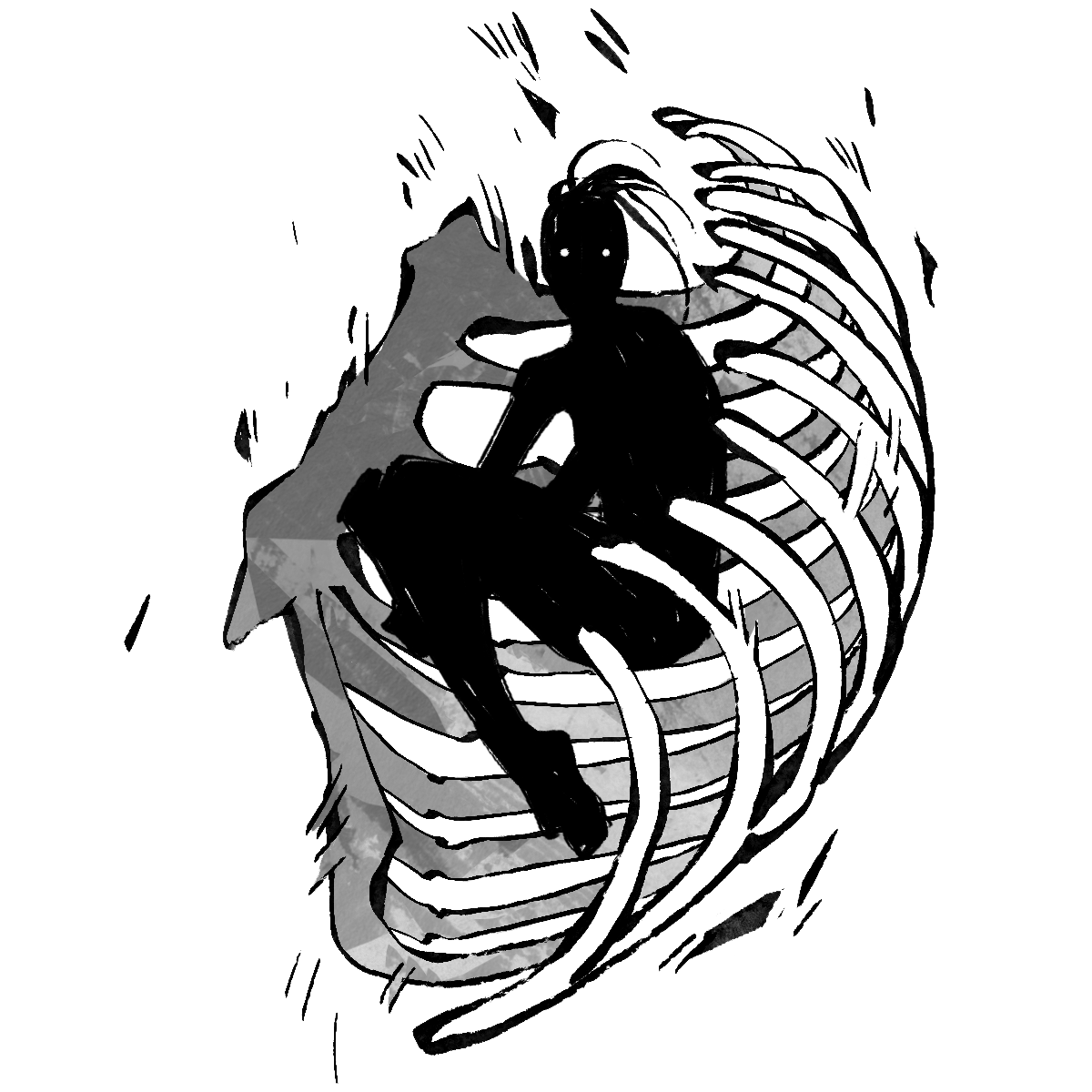
Another stir around the basin, in the hope of encouraging the fire’s gluttony. The disarticulated arm inside sizzles, taunting, as defiant as its owner. Most of the flesh has been lapped away up to the wrist, revealing bones, slow to blacken. The delicate hand remains intact, deep bronze and lacquered with liquefied fat, as its three fingers—my mother had to leave some if she wanted to hold a knife—char. I press the end of the poker into the palm and the fingers curl inward, then the hand breaks free of the radius and ulna, rolling away from me. This is all that’s left, the last piece my mother cut from her body before her death. Rusty strips of crackling skin flutter through the air, bisecting the column of clean white smoke as it twirls over my head.
The Darkness snaps at the flakes of roasted skin, its form as hazily defined as the night sky. It’s been creeping closer and closer to me since my mother’s death, now hovering just feet away from where I stand. Though it has no features to twist into an overt display of disdain, I feel its resentment pressing against me, same as the fire’s heat. Its remaining arm is frail and listless without my mother’s bones to support it. She shed this Darkness, but she failed to banish it.
My mother’s burning flesh exhales its honeyed heat into my nostrils, whispers acidic kisses against my lips, intertwines with my hair, my breath, slicing through the bruise-black sky, lacing between the stars, dancing endlessly upward until it caresses the moon.
• • •
I had a custom coffin made for my mother. It cost the meager savings my ex tried to steal from me—and a reminder from my boss that I was out of PTO so the funeral best be on the weekend—but it was the most purpose my money’s had in a long time. I worried the monks at the wat would find such a thing strange, but once they saw her, they understood. Spine so bowed the mortician couldn’t straighten her, my mother was placed on her side in the square box, her remaining arm on top and her head facing where her legs ended just below the knees. Not ideal for Thai customs, so the monks multiplied their prayers. The mortician had to put some sort of padding in her dress to fill the section of her back she’d carved away, ribs and all.
Even after the coffin was closed, all I could think about was how small she had become. My mother was always petite, but after my grandmother’s death, the shrinking started, her body diminishing under something heavier than the weight of time and age despite what her doctor said. Every year, she got a little smaller, her neck more bent, her shoulders sloped so severely she had to switch from her usual handbag to a fanny pack. My father never noticed, and she never told him. For most of her life, she hadn’t wanted anyone to know about the creature that sealed itself to her. That eventually crushed her.
Her mother—my grandmother—had been the same, an image that prepared me for my own mother’s demise. She’d carved away at her body too, then set what was left on fire.
In my memories, Grandmother was always severely stooped, bent at the waist and neck, shoulders so sloped she often stood with her hands braced on her shins. Though I couldn’t see The Darkness at the time, I could see the dent it made in her spine, how she crumpled under its weight as it straddled her, the shadowed hollows where it gripped her neck. When Grandmother cut off her left arm, my mother bandaged what remained and tended to her at home, all under the neighbors’ “concerned” speculations of dementia and mental illness. At Grandmother’s direction, my mother burned every limb she’d severed in the backyard. Even though burning garbage was common back then, those concerned white neighbors assumed incompetence and maleficence.
How could my mother explain to them that to free the soul the body must be burned, even in pieces? That if one is haunted, like my grandmother and mother were, she must carve away The Darkness, even if that includes carving away her own flesh?
I wouldn’t have understood either, having been raised in the US, fully assimilated into a world of shopping malls and unchaperoned parties. My white father was long gone by then, his influence maintained by a mother who wanted me to fit in, to have the carefree life she and her mother never did. When I was young, it was easy to view Grandmother as the neighbors did: strange, delusional, a threat to the purity of their perfect suburban community. I was fascinated by her rituals and my mother’s compliance, but too embarrassed to tell my friends. My mother didn’t want me to know about The Darkness, and I was fine with that.
After Grandmother’s death, my mother started to complain of back and shoulder pain. At first, she bent elegantly: a graceful curve to her upper spine that could only be seen when her back was exposed, a rounding of her shoulders that made her appear even smaller, a slight bend in the back of her neck so that she always seemed demure. By then, I was a self-absorbed preteen; I didn’t connect this change in my mother to the shape my grandmother took toward the end of her life. My mother would wince at mirrors, and when she could no longer reach up far enough to squeeze my shoulder in the gentle and reassuring way she had always done when I was upset or scared, she started slamming her back into the wall.
Though she was only in her early forties, she spoke of cremation often, how the body is a cage that can be opened only by fire. I wouldn’t know until years later that she was talking about the creature. The Darkness.
Shortly before she died, my mother spoke of burial instead. It seemed an odd change of plan, mentioned late at night when her words were slow and smeared from blood loss as I bandaged the remnants of her severed limbs. When I found she hadn’t updated her final wishes, I deferred to the monks. I spread her ashes as she had originally dictated, and pictured her soul soaring free of melted flesh and charred bone, riding the smoke of her remains as it streaked a clean white ribbon across the night sky, twirling between the stars, dancing through endless space. Finally free of the cage that had bent her into its confines.
• • •
These backyard fires have never burned hot enough to obliterate everything, so it’s not a shock when I’m left with stubborn fragments of bone among the ashes. Dawn streaks purple and orange over the ambling night, giving me little time before daylight blights my meager privacy. I take the cooled fragments to a row of red-flowering currants in the corner of the yard, the farthest from Gregory’s sight. The pieces are small, secure in my palm, but I’m still surprised by how light and hollow they feel, as if everything that made my mother has fled with her soul. Every striation tells of her tenacity, every cut a record of these measures of control.
The ground fights me as I dig. I’m on my knees, garden trowel and sweaty hands plunged barely six inches into the unforgiving earth, when I sense The Darkness lurking nearby. It’s fuzzy-edged and deep as velvet against the emerging morning, an almost beautiful nothingness dragging its form towards me through the grass. It stops a few feet away, its one arm bracing its body, the remnants of its legs dissipating into the dirt behind it. So small now, but still heavy and infinite. I wonder if it’s as tired as my mother was. No one left to carry it, flesh without armature. It’s a piece of my grandmother, and I want it to be as free as my mother is now, but part of me finds grim satisfaction in seeing suffering itself suffer, pain incarnate lost and flailing.
The Darkness shuffles closer, curiosity in the heat it radiates across the back of my neck. It cocks its eyeless head as if considering me. I have a sudden urge to hide my mother’s bones, tuck them beneath my folded legs before The Darkness tries to claim them again.
“You need some help there?”
Gregory again. Perched on his stepladder, leaned over the fence so far his pajama top gapes in the early morning breeze. He looks so small now, nothing more than a pathetic man who’s never felt the jagged edges of his kind of judgement.
“I’m fine,” I say, shifting so that my mother’s bones are out of his view.
“I’m sorry about your mother, you know.”
There are a million things I could say. But I shouldn’t have to say anything. I should be burying the last of my mother, alone, in peace.
I turn my attention back to my task, keep chipping away at the angry earth.
“I’m trying to be nice here,” Gregory barks. “Wouldn’t hurt you to be cordial back.”
Heat slithers up my neck, across the back of my head, its long fingers unfolding over my face. I can’t tell if it’s simply anger or if The Darkness is finally daring to touch me. “You were never nice to my mother when she was alive,” I say.
Gregory scoffs. “I was perfectly nice to her! I’m a good neighbor—”
“All you did was harass her! She brought you cookies on holidays and you threw them away. You made assumptions, decided we’re strange and wrong because you’re so small, your world is so narrow you can’t see past yourself! They were regular sugar cookies, you moron.”
The early morning breeze turns hot and thick against my ears. The Darkness presses its weight as low and solid as a hip sway into me. I thought it would simply dissipate upon my mother’s death, released like her soul in a column of clean white smoke, but its anger rises with mine, and I feel it sipping from me, feeding me. I should’ve known how stubborn it would be, how it would keep searching for purpose even after its duty is done.
“Your mother needed help,” Gregory says, leaning even farther over the fence. One more step up and he’ll be in the yard. My mother never had a moment of peace, even in her own home. “Falling apart, hurting herself—” He lowers his voice here, as low and throaty as a threat. “You sure as hell never tried to stop her. Maybe you should’ve been here more. Did you ever consider how lonely she was? I know you young women love your careers and your boyfriends, but what about family?”
My dead-end job, my thieving ex, my aimless life. Even unknowingly, Gregory pours salt in the wounds of my failures.
Guilt burns as savagely as the rage thrashing against my ribcage, an inelegant flame sparking on my tongue, but The Darkness slides its lone arm across my shoulders before I can respond. I freeze, terrified that this is the moment it’s going to crawl onto my back and seal itself to my spine, but then my muscles loosen when it moves no further. The spirit’s arm is light, its remaining fingers gently squeezing my shoulder. Behind me, my mother’s bones are waiting, vulnerable to Gregory’s searching gaze.
I go back to digging. Gregory laughs, a smug, dry huff. “Got nothing to say to that, huh?”
The Darkness squeezes my shoulder again. Gentle, reassuring, as if it’s a piece of my mother telling me it’s okay, reminding me this tiny nothing of a man is not worth my racing heart, my breath. We wait together, my fists in the dirt, listening to Gregory shuffle down his stepladder, mumbling to himself until his door shuts behind him.
Before it leaves too, The Darkness kisses my temple. Burgeoning sunlight chases it across the lawn, smaller, smaller until it’s bled back into the shadows. My mother’s bones are warm in my hands, the harsh odors of smoke and sulfur fading as I nestle them into the waiting earth.
• • •
The amputations started after I left for college.
“Luuk, there are things you shouldn’t know,” my mother told me the first time I came home to find her without a leg.
I begged her to tell me what happened, cried in fear and confusion when she informed me she’d done the butchering herself on her kitchen floor. She firmly dismissed talk of doctors and mental health professionals, reminding me to respect her, that she knew what she was doing. She’d been ground down into the same groove her mother had worn.
“It’s my duty to carry this, but I can’t let this be your duty when I’m gone.” Her words fell heavy on me, an admission steeled with purpose even when swaddled in the soft resignation of her voice. “Your grandmother, she tried to free herself, but I’m cutting it free, so you won’t have to carry it.”
I remembered the smooth indent that had made a saddle of Grandmother’s back, how her knees buckled under an invisible weight that forced her gaze down and her head low. Smaller and smaller. I never learned enough Thai to understand what she spoke of when her face turned from grim to hard and her somber eyes animated. But, even as a child, I recognized the name she repeated when her pain was at its worst: Chao Kam Nai Wen.
The embodiment of suffering itself, the ghost who haunts her abuser by perching on their back. Wearing down their flesh, their muscles, their bones so they will forever suffer the weight of what they’ve done. An otherworldly justice in a world so often without.
I didn’t understand what my grandmother could’ve done to deserve such a fate.
“Back then, Thai people . . . we had to accept what our families did,” my mother continued. Though I sat on the floor, lower than her, her downward gaze would not meet mine. “People—men—do terrible things, but we have to respect the family, what’s best for them. We have to trust that the man will pay in another way. My mother had her purpose and now it’s mine.”
In that moment, I realized that she’d rather burn the weight from her bones than say the words out loud.
“Her family, they treated her like a curse,” my mother said, hands restless in her lap. Only then, I noticed she was also missing a finger, and my stomach turned, realizing this wasn’t the first time she’d cut away at herself. “In those days, abandoned children had no hope, no help. She said they were good people for taking her in, despite how they treated her. She knew what she was before they did, that she was punishment for her adoptive father.”
So Grandmother hadn’t done anything wrong. She was both a victim and a weapon, a Möbius strip of suffering.
Barely into adulthood, I sat at my mother’s feet and listened. She spoke with a clarity that came with age, or the exhaustion of maintaining an image of herself and her history beyond the specter of long-dead kin—I wasn’t sure—admitting no one knew how or why Grandmother had been left as an infant outside her adoptive family’s gates, a little girl endlessly hungry for love and attention. But they knew she was not their own, and her adoptive family merely tolerated her.
My grandmother’s adoptive mother raised this little stranger under the heavy eye of neighborhood gossip and her own suspicions. Whether her husband accepted this because my grandmother was the product of an indiscretion, as the neighbors speculated, or because he owed a karmic debt, fluctuated in the stories my mother heard. Despite his disinterest that putrefied into revulsion as she grew, Grandmother yearned for her adoptive father’s attention and refused to leave his side. He complained of back pain so severe he couldn’t raise his head. Soon, he could no longer work.
The women of the family suffered dutifully, taking in laundry and cleaning neighbors’ homes for money. The men broke under the weight and chose suicide, starting with Grandmother’s father. Their bodies were swiftly cremated, their souls freed by fire. Grandmother’s mother was the next to stoop, her neck bent and her back rounded with a new weight. When the old woman’s body finally gave out, my young grandmother saw she’d lost her purpose and left home.
Her given name was lost to time and the absence of government records, so she was simply “luksaw” in the frayed ribbons of family gossip my mother could recall. To me, my mother called her Mae, but she didn’t tell me until years later that that was simply the Thai word for “mother.”
Mae left Thailand shortly after my mother did. Once carved from the remnants of the family that raised her, she destroyed herself piece by piece, trying to burn away the duty, the purpose that bent her body and made her its own. Her only mistake was self-immolation. Her soul was finally freed, but she couldn’t have known the consequences, the price that would be paid by her descendants.
“Grandmother was the Chao Kam Nai Wen,” I said, shifting at my mother’s feet. Her house was suddenly cramped under these revelations, the spirit gulping the oxygen from the living room as it materialized before me. In the hazy yellow light of afternoon, it perched on my mother’s back in a wide-legged squat, its hands pressing downward on the back of her head. A part of my grandmother, separated from her incinerated body, lost and languishing, anchored to the last piece of herself in this world. “Why wasn’t she freed when her adoptive father died?” I asked. “Why is she haunting you?”
“His death didn’t end her suffering. He is free and she still isn’t. She needs a purpose, and all she knows is pain. We carry her until she’s satisfied.”
“But she’ll never be satisfied, and she’s wrong for punishing you. His lineage is gone, right? It’s just you and me.”
“And it ends with me, you understand?”
“How? You cut off your limbs but she still hangs on. You can’t cut off your back. If you die, she’ll be free, but—”
“This will not be yours, luuk.”
I wanted to ask how she could be so sure her unthinkable actions would spare me this fate, but I understood then that her resolve was crumbling, doubt and fear dismantling any confidence she had. Though I didn’t know exactly what my grandmother’s adoptive father had done, I knew it was horrific enough that my mother had invented a different history for herself. The shame and guilt were not hers, but she was a representation, and slicing its consequences from her body was the only control she had.
As my mother’s gaze finally turned to me, the Chao Kam Nai Wen shifted with her, its single arm hooked around her neck as it struggled to keep from sliding down the steep curve of her back, its remaining leg flailing against the empty space where my mother’s leg had been. It was savage yet delicate work that consumed my mother, cleaving her body to unmoor the thing that whittled down her shoulders, fused to her back like a lost and lonely child.
Like with her own mother, The Darkness wore her as if she were its bones.
• • •
The Chao Kam Nai Wen should be in the ground now, twined around the spine it contorted, the shoulders it stooped, its remaining hand plunged into my mother’s chest cavity and grasping for ribs as they fall away. Trapped for all eternity in a wood and metal box with the bones it once wore. I know that’s why my mother changed her mind, why she spoke of burial instead of cremation at the end. Guilt settles like the Chao Kam Nai Wen atop my spine for going against my mother’s wishes, but I couldn’t leave her in the ground like that, her soul unable to ascend. She doesn’t deserve that and neither does the Chao Kam Nai Wen.
I let it have me. Her. But she doesn’t wear me, not like she did my mother. I wear her.
After burying the last of my mother’s bones, I head inside for some sleep. The Chao Kam Nai Wen is merciful, but I can still feel her creeping around the bedroom, her fingers daring to hover over my exposed limbs, pulling herself up onto the bed even as my breath quickens. She slides her arm across my shoulders again, nothing more. Lost, her purpose fading though her anger and the sorrow do not. I feel the same; all that waits for me at home is a job I hate. And all that’s left here is a house I must clean out and sell.
I sit up in bed and nudge the Chao Kam Nai Wen behind me. Her one arm hooks around my throat as she struggles to boost herself onto my back. I bend, allowing her to drape her warm weight over my spine, across my ribs. Her grasp is firm but tentative. In time, her limbs will grow back if she stays fused to me.
We spend the day together, waiting for night. This Darkness, she’s not so heavy now, though I know that will change over a lifetime. My mother did the hard work of carving her limbs away, lightening my load. She didn’t want this for me—she bartered her life, her eternity, so I wouldn’t have to carry this burden—but what if I’m just as lost? What if I welcome the duty that anger brings?
Shortly after midnight, we build a fire in the backyard. We fill the metal basin with firewood, newspaper, and expired meat from the refrigerator. Rancid fat crackles in the mouth of hungry flames.
Gregory’s on his stepladder, yelling into the orange glow even sooner than I expected. “What the hell? Again?”
I spread my hands over the fire. The Chao Kam Nai Wen tightens around me before releasing her hand to do the same. She’s still unsure, but I won’t let her fall.
“I won’t tolerate this from you too. You people come into this country and think you can do whatever you want . . .”
I don’t respond, don’t even look at him. The Chao Kam Nai Wen and I stare into the fire, comforted by the familiarity. I thought she would be afraid of the flames that burned away her bedrock, but she shadows me, breathing in the black, acrid smoke. I roll my shoulders and the Chao Kam Nai Wen spreads all the way around me, wrapping her mass like smooth, cool silk over my torso. I tuck my left arm into the dent my mother carved into the creature’s back. I picture my legs retracting into her body, my head nestling back into hers.
Eventually, Gregory stomps down his stepladder while grumbling about how he’s going to call the police and I’ll be sorry. He’s just a pathetic, bitter old man, but he’s a start.
We’re fast—the Chao Kam Nai Wen and I scale the fence, scramble across Gregory’s lawn, catching his pale, spindly ankles just as he’s stepping onto his porch. He’s facedown before he can get any words out, concrete smothering his screams as we shape ourself across his back. We plunge through worn cotton, braid onto the rising knots of his spine, push our hands into the back of his neck. It takes him a few attempts to stand, and when he finally does, he’s unable to straighten, already bent by our new weight.
Disoriented, he sways, looks back toward my mother’s empty yard. Then he turns and catches his reflection in the dark glass of his back door.
I hope he sees us. I hope he sees the purpose in our smile.
• • •