

Here’s what we know about the Northerners. They came in tall black ships that moved against the wind. They were pale and furless and spoke a language that sounded like breaking glass. They came when our cities were at their mightiest and plundered them and razed them to the ground. The survivors of their rapine were crammed into pens belowdecks, where they had to shit where they slept. They were hosed down like livestock and fed from troughs. The strong were taken away to slavery. The weak they took onto the barren northern beaches and sawed open their throats and butchered their corpses in full view of their wailing families. They smoked their flesh over sorcerous rocks that burned when ignited. They ate it sliced thin over black bread.
These are the things my parents are certain were true.
There are other things as well, but my mother called them fairy tales, and my father said they weren’t even that. That they took our women to despoil and father a slave race of half-breeds. That they ate not just our bodies, but our hearts and our souls also. That they were wraiths, or demons, or monsters whose flesh was ice and blood was slurry. Or—that they were our punishment. After all, hadn’t we done such things in our own time? Hadn’t our ancestors also sailed south and enslaved and raped and pillaged?
We speak about all this the night before I leave. My mother pottering about as she always does when she’s listening to something carefully. My father, machine grease in the wrinkles of his great palms, broad-faced and short-snouted and red-gold in the lamplight. “We were never like that,” he says. “We were never so cruel.”
Here is another thing we know about the Northerners: they only came when there was no ice. So we look out across the bay to where the headlands draw together like stony lips. The water grey-black in the late dusk and the dim scattering of lamps in the houses along the shore. The late winter slouch of the sun. The crawling offshore wind. No sign of ice for the ninth year running. No sign of any Northerners either, but we don’t look too hard or for too long. Punishment flocks to those who seek it.
• • •
We set out aboard a brig with a blackwood hull and sails as clean as the winter sky. To be aboard is to constantly switch between two worlds. Abovedecks is a leviathan hollow of sky and ocean, where life is small and easily swept away. Belowdecks is a creaking cocoon ripe with the stink and suffocating press of others close by, always close by. As scribe and notetaker I’m too lowly to warrant my own berth and must sleep where I can, but I’m one of only three on board who can write, and that at least affords me a dash of respect. The other two are the captain and the merchant who hired the ship. The latter positions himself by the prow with his legs apart and his arms crossed as we set out. A muscular man with a moon face and a stubby rubber-lipped snout.
The captain leans against the gunwale to port, as dour as a chimney and as grey as smoke, staring northwards.
“Ladies and gentlemen!” says the merchant. “Welcome aboard my ship. This isn’t going to be like any other voyage, you hear? This is a voyage of science, and discovery! The northern passage is open for the first time in generations. Islands lost to civilization for three hundred years are supine before us once more! We must only reach out, and take what they offer.” He clenches his fist, fingers fat and red and tight-skinned. “I know some of you are afraid of the boogieman. The Northerner. Let me tell you—you have nothing to fear from them. They are not magic, but flesh and bone. We know now that their ships moved with steam power. We know that their magical burning stones were just coal. When they last came our barbarous ancestors set upon them with bows and arrows. Of course they were vanquished! Now we have muskets and the finest combustion engine money can buy. We are the hunters now, and we need only think about pursuing our mighty quarry.”
He pauses in anticipation of cheers, but all he gets is the chief flenser crossing her arms and clearing her throat. Her rough skin red and sucked against hard muscles. Her oily hair in a bun atop her head. “Wassat?” she says.
“Pardon?”
“Watsa korry?”
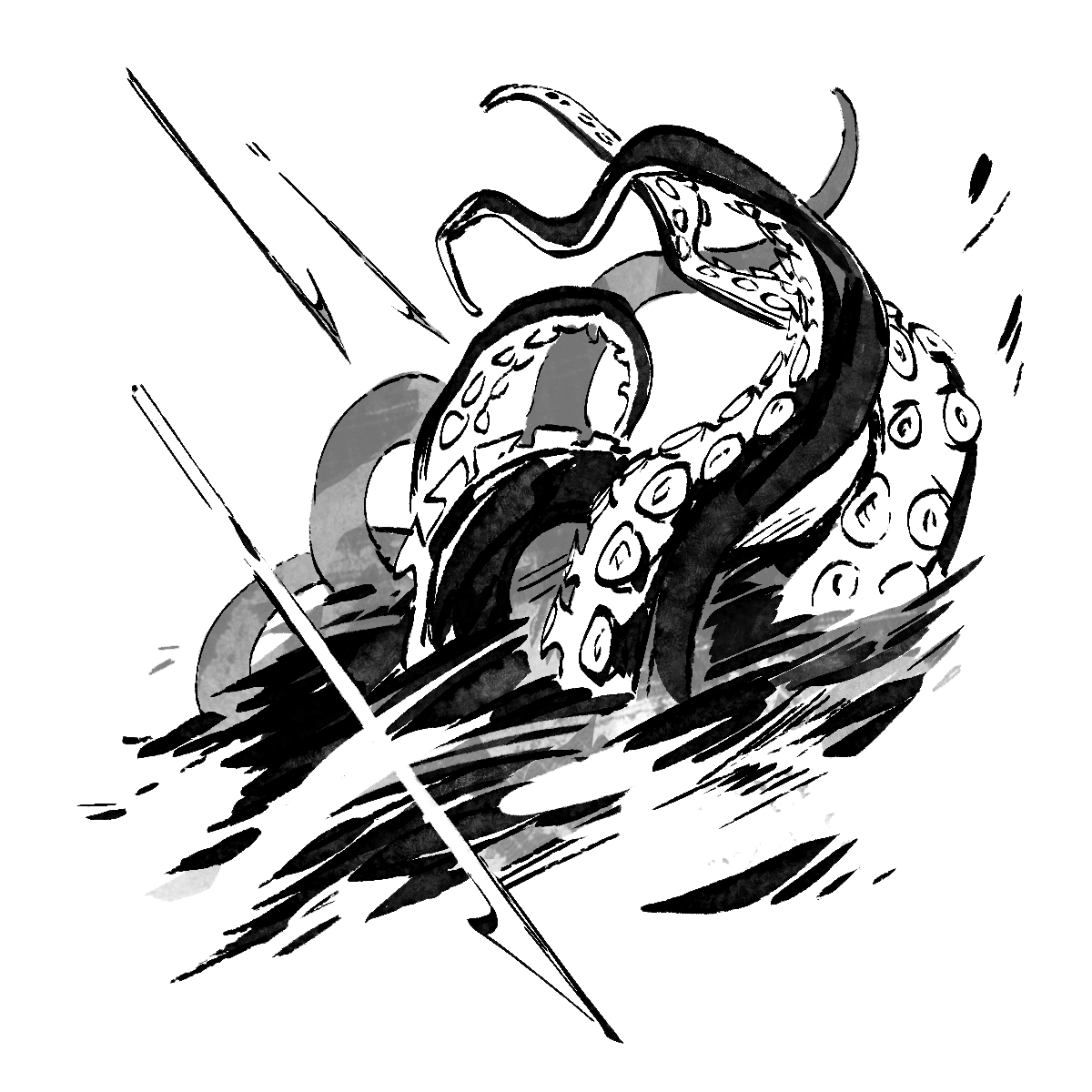
“A quarry?” The merchant blinks. “Why, our prey, of course! The lords of the hadal deep! The tentacled monstrosities that—”
“You mean skolls?”
“Yes! Yes! Skolls!”
The flenser shakes her head. “Ain’t no musket what can get through a skoll’s shell, mister.”
The merchant nods as if he’d expected her to say precisely this, and steps aside with a smile. Behind him is some great shape squatting beneath a tarpaulin like a gargoyle in a greatcoat. He pulls the cover with great effort and finally it comes off and beneath it is a gun at least three times as long as a musket, and four times the bore.
“A harpoon gun!” he says. “This will crack a skoll’s head with one shot. We’ll pack this ship with their shells and their ink and be back by midsummer’s eve. Think of it! You’ll all be rich this time next year!”
Now the cheers come. Watery and half-hearted, but undeniably there. Then the captain walks away and everyone takes it as a signal to get back to work. I, though, have nothing to do, so I linger with a single deckhand, and together we inspect the weapon in silence. He turns to me, a shrivelled and one-eyed thing, scraggly-furred and pungent and missing a couple of teeth. Young, and yet flotsam already.
“Shouldn’t be hunting skolls,” he whispers.
“Why not?”
“Is bad luck.”
“Why’re you here then?
He shrugs. “Coz I’m poor.”
No better reason for it, I suppose. Better than for greed, like the merchant, or because, like the crew, it’s the ocean or the grave or the jail. And better than me, for I am not here through compulsion. The money will be good, and help. The time away from home will be welcome. But I am here because I must do something before I start the rest of my life. Travelling to the ends of the world will at least give me something to talk about.
I am, in my own way, flotsam.
A couple of kids watch us from atop the ice-cracked ruins of a tower on the headland as we sail out to sea. Black flecks against the ice-blue sky. They wave. Even flotsam, I suppose, may dream of where it beaches.
• • •
We head north. Up past an island crawling with unfriendly folks who look an awful lot like us, but speak a language we don’t understand. Two of them climb atop the turf roofs of their squat cylindrical huts and wave matchlocks at us and urinate in our direction. After that for six days there’s nothing but shale-grey water and a horizon as sharp as snapping bone and the captain a solemn figurehead at the prow, gazing north. Presently our breath starts condensing even at noon, and we pass an iceberg. A vast thing unbothered and serene until our wake somehow sets it tumbling. The tilt of its enormous sides. The striations upon its newly visible belly, white upon blue upon black. Each, I know, was once a layer of rain or snow compressed into this vast oceanic gemstone. In that, time and the ocean depths are much the same. What we lose to them we can never regain, except in altered approximation.
We see our first skoll a few days later. At first it’s just an anomalous glimmer off to starboard. A slab of ice perhaps, or some flotsam. But the scraggly deckhand keeps staring, and then he points and hoots. It’s then that we see the lidless eyes and a spread of panicked tentacles seething beneath the glassy waves.
The merchant clambers red-faced up from belowdecks. “Forth!” he yells. “Go! Go!”
Men and women surge across the deck and up the rigging. The butterfly fold of the great sails. The judder underfoot, as the engine grumbles to life. Soon we’re steaming after the skoll against the wind. The merchant fiddles with the harpoon gun as we go, and I see now that it rotates and tilts atop its mounting. We close in on the beast amidst froth and chaos and I lock eyes with it and see nothing in its slit pupil but a depthless dark.
That can’t be right, I think.
The merchant fires. The harpoon spits from the barrel, sharp and cruel and serrated. The cold glint of its flying shaft. The concussive crack as it splits the beast’s shell. What a strange thing it is to see so vast a monster flinch. How horrifying to know that nothing is too large to suffer. The projectile sinks deep. The merchant activates the yanking mechanism and a great hunk of the creature’s armour rips off and tumbles into the water. Its legacy is a blotch of raw and weeping flesh. “Look how much damage it’s doing!” screams the merchant. Then he points to where another skoll surfaces half a fathom away, smaller, pink-shelled, swimming in circles. “Look! Another! This one has young!”
The merchant reloads and aims and fires again. Again he hits the monster’s shell. Again he rips off a great hunk. The captain inspects the gore and hands the wheel to the chief mate. Then she clops over to the merchant with her skinny face bloodless and her fists clenched and the fur on her neck bristling. She seizes the harpoon gun and fires at the skoll’s head, once and with precision.
The projectile sinks a third of its length into the creature’s skull. Its eyes roll up, and it dies.
The merchant wrestles the device back. “What—”
“We haven’t time for your fuckery,” she growls. “You shoot it once, and in the head, or you don’t shoot at all. Do you understand?”
“Why—”
“Look at those things. The longer we fight one, the more dangerous it is for my men. We’re not here to show the ocean how big our guns are. We’re here to take what we need and leave.”
“But—”
“I am captain of this ship. That is my word.” The captain’s eye twitches. “Tell me you understand.”
The merchant examines the captain’s face like a thief examining a safe.
“Fine,” he says. “I understand.”
The flensing crew fling their hooked ropes overboard and pull the skoll to the ship to commence their harvesting. The swift squelch of the butchery. The gloss and drip of the beast’s extracted innards. I watch, aghast, until I notice something else watching too. Another pair of alien eyes, smaller and far away, eyeing the scene in silence. I see nothing in them either. Perhaps, I think, it’s because they live so very deep. Perhaps the dark and the pressure compress even fear and sorrow into something the likes of us up here can’t quite recognize.
• • •
The young skoll starts off north before we let the fragments of its processed parent sink into the depths. We set off after it, through a reach where there’s nothing but the wind and the puckering sea and slabs of ice scattered upon it like glittering scabs. The captain stares at the horizon a lot and tells whoever’s in the crow’s nest to do the same. We see just one island, a lone peak shedding wind so dry it turns our skin to parchment where we stand. Its raw shores are littered with grimacing bear carcasses and the wreckage of a skiff, grey and gnarled and impossible to age. How did it get there, we wonder, and why? The world is made of forgotten stories.
In the mornings the sky is hazy and sometimes there’s a ring around the sun that the sailors call a sun dog and the cook, a southerner with long jowls and an underbite, calls the crown of heaven. Whenever he sees it, he claps his hands together three times and bows and mutters a prayer in his strange and throaty language.
When he’s not there, the scraggly deckhand tries to mimic him, but no one laughs. The flenser smacks him around the back of the head.
“Don’t make fun of his gods, you retard,” she growls.
“But-but them gods ain’t real.”
“Who knows what’s real out here.” The flenser shoves him away. “Who knows what gods are in these waters.”
One midafternoon the lookout spies a vessel on the horizon and screams as if a Northerner was up in the crow’s nest trying to eat her at that very moment. Within a few minutes we’ve fetched our guns and fired up the engine and gathered on the deck to watch the thing. Our knuckles white on our barrels. Our throats tight and our bowels clenched. The distant fleck begins to dwindle as we move away, until abruptly one of us realises it’s not a ship at all, but some sort of canoe. Then we turn back towards it and closer we see it’s holding two figures paddling furiously with carved whalebones. They turn out to be skinny women with moustaches tattooed on their upper lips and faces as rough as sailcloth. Identical to us in the generalities but taller and paler and bigger-eyed. When we bring them on board they stand close together with their hands behind their backs and won’t look any of us in the eye.
“Where are you from?” asks the merchant.
The women glance at each other, and say nothing.
“We’re looking for skolls.” He wriggles his fingers. He mimes a shell. “Skolls. In sea. Where skolls?”
The women whisper to each other. Then one of them reaches into her coat and pulls out a dagger and shows the hilt to the merchant. The merchant examines the densely carved ivory and nods. “Yes, like these! A skoll. Where?”
The women chatter again, and point. North. Then they touch their foreheads with their index fingers and point south and say something. Their expressions mild, but their voices outraged. Like we’d offered them inferior goods. Like we’d proposed marriage too early. Eventually the captain gives them some lumpfish and a bottle of skoll ink and lets them go. They row away fast, due southeast, slanting across the haloed sun. As they go they take turns sniffing the ink, and then tip the bottle over the side.
“Savages,” mutters the merchant. “What a waste.”
The captain sniffs. “I’m giving this three more days. Then we’re turning back.”
“Three days? Nonsense. We’ve plenty of time.”
“Haven’t seen fish in days. We’re running out of pickles too. I’ll not have the men get scurvy.”
“No one’s getting scurvy. We can use the harpoon to score a whale if we must and eat the blubber.”
“I’ve seen no whales either.”
The merchant spreads his arms. “Have faith, friend. My ship is a lucky one.”
For a long and grinding moment the captain stares at the merchant with her eyes narrowed and her lips pulled back from her teeth. “I am not your friend,” she says quietly. “And this is not your ship.”
“No need for aggression, captain. You’re getting well compensated for this.”
“Can’t eat money. Besides, we’re not alone. I can feel it. I’ve been feeling it for days.”
The merchant grins. “There’s no man-eating boogiemen out here. Just ice and water and the untapped bounty of the deep. Have you no curiosity? Don’t you want to know what’s out here?”
“Of course I have curiosity. It’s you who don’t.”
“Pardon?”
“Curiosity is the desire to learn.” The captain spits over the side. “You don’t want to learn. You want to dominate. That’s not curiosity, that’s greed.”
The merchant eyes the captain, flinty, and shrugs. “You’re conflating a trait for motivation. Curiosity is still curiosity, whatever purpose it serves. Be grateful for my greed, which has filled your coffers. We have ten days left before our contract stipulates you turn back. Until then, onwards. Chop chop.”
The merchant waddles off. The captain examines the horizon for a few moments. Then, jaw clamped, she resumes the chase.
• • •
The map says that there’s a small archipelago due east and the merchant says that’s where the baby skoll will go because it’s afraid, because when afraid, beasts try to recreate the safety of the womb. I wonder what my mother would say if someone told her I died wishing I was in her arms.
The wind is still as dry as old bones. We keep seeing things on the horizon, when we know there’s nothing there.
We sail in amongst the islands two days later. No sign of the skoll in all that time, and the captain seems fine with this. The channels between the blasted shores are deep and blue-grey and home, at last, to shoals of silvery fish. We take in two hauls and eat them sliced and raw and leave the rest in boxes on the deck to freeze solid.
“Luck comes to those who seek it,” says the merchant as we work. “Now we needn’t worry about food.”
No one pays him the least bit of attention. I don’t want to hear what he has to say, but still I don’t want him to be speaking to nobody. I wander up beside him and lean on the railing too and look out at the islands. The slabs of weathered granite, and the brown-grey pebbles by the sea. The ice devils swirling in little packs across the dead coast.
“Fascinating place, what?” says the merchant. “Virgin lands.”
“There’s not much here,” I say.
“Not to the untrained eye. There are minerals in those rocks, child. Minerals to be refined and extracted. Yanked, as it were, from the granite grip of the earth.”
“Can’t we do that back home?”
“Indeed we could. But who knows what’s out here? What precious metals and wonders?” The merchant sniffs. “We’re at the end of the world. The frontier. Places where new knowledge comes from.”
“A frontier to us. Not to the Northerners.”
“How do you mean?”
“I mean, this is where they’re from, innit? The north? This is their home.”
The merchant chuckles. “Oh, no, no. They’re not from here. They just sail through here. See, the world is a ball—”
“I know.”
“—and what they do is they sail over the top of it to get to where we are. They’re from the other side of the world. They don’t live here. What would they live on? Ice and rock? Absurd!”
I straighten. Thinking, next time, I’ll let him speak to no one. “Alright.”
“You see, child, the Northerners aren’t Northerners at all. This is neutral ground . . .”
His voice trails off. We’re passing by a little bay to port. A shallow and vivid blue disk of water sunk between two spits of land. In it is the baby skoll, paddling in circles.
The merchant grins.
“I’ll wager they came this way to hunt skolls too,” he breathes. “I’ll wager they just killed us because we got in the way. They’re just like us, child. Perhaps that’s why they don’t like us very much. To arms! To arms! Our quarry is sighted!”
He dashes off and leaves me to watch the skoll. It flails, trapped in an ice-cold womb.
• • •
This is how our encounter with the Northerners goes.
We’re in the bay with the ship right up against the skoll. It’s darted around in the waters for an hour or so but we block the exit with two skiffs and corral it in the shallows. At one point it looks like it might beach itself in its desperation and the captain tells the merchant to hold fire to see if it does, but it doesn’t. It just jets back and forth in the crystal waters instead. It’s small—barely twice the size of one of us—and pale. It is a child.
“Oh god,” whispers the cabin boy. “Oh god, poor thing.”
One of the skiff teams races to cut it off as it makes for a gap. The merchant shoots. The sudden thud of the harpoon’s ejection. The splash and clank as it misses the creature.
“I did not give you leave to fire!” snarls the captain.
“What’s wrong with you?” The merchant triggers the yanking mechanism. The harpoon comes dragging through the water like a dead metal fish. “This is sabotage! You don’t want me to capture this beast.”
“Look where you’re firing! My men are down there. Let them fall back before—”
“I won’t hit your men.”
“You will not fire until—”
This is the very instant the Northerner ship enters the bay. We all know immediately what it is. A pale grey thing more alien even than the beast frothing in the water to starboard. It crests the headland without fanfare and proceeds in sinister silence straight towards us. The plough-sharp bow like a blade on the water. The bulges and boxes on top, where a plain deck should be. No sign of sails anywhere and no signs of smoke from an engine either. We should be running for our guns and our lives but no one makes a move. Each and every soul is frozen, not from fear, but from enormous and iceberg-heavy disbelief that this is really happening. Your own life is the most important story you ever tell. It’s not supposed to end like other people’s.
The men on the skiffs panic well before the rest of us up on the ship. Two of them shoot and the musket balls ping off the Northerners’ hull with all the impact of a pair of snowballs. A third dives into the death-cold water. The rest rally and set to rowing out of the interloper’s way. The Northerner vessel makes no effort to change course but as it approaches it slows down just enough to let them go.
This is the first thing it does that I don’t expect.
Then it sails in between us and the skoll. One of the structures on its deck is undeniably a gun and this moves to point at our hull while compensating perfectly for the swell. I expect a blast of some eldritch weapon but instead the ship rotates on the spot by way of a gurgling sideways gush of water with the barrel still trained on us. Then it butterflies a hatch on its stern to reveal a darkened and already-flooded compartment. The skoll eyes the opening for a long time and does nothing. Some great and inchoate process of thought unfolds inside the creature, in terms beyond our comprehension, and arrives at conclusions even farther away. The sea spray pearly about its shining shell. The world upside down and arched against the gloss of its eye. Then the ship lets rip with some long and reverberating drone that echoes off the raw rock of the hills like a prayer to the slow-thinking earth itself.
The men cover their ears and scream but to the skoll it’s some kind of summons. It rushes straight into the ship’s depths, and the doors swing shut behind it.
The vessel turns, and heads towards the entrance of the bay.
The merchant watches with a look like his face had been painted on a deflating balloon. “What?” he breathes. “What? That’s my prey! This is against the rules of the sea!”
He reaches for the harpoon gun, but the captain intercepts him. “Stand down,” she snaps.
“It’s against the rules of the sea!”
“What would you know about the rules of the sea? Stand. Down.”
The merchant roars and shoves her up against the gunwale. He’s twice her size but she’s springy and ligament-tough and is back on him in an instant. They struggle up against the side with the captain shouting “Stay back! Stay back!” to the sailors approaching with their knives already drawn. The merchant clamps his huge hands on her neck and squeezes. Eyes skoll-wide and lips purple with effort. For a long moment it looks as if that’s how things will end. Then the captain contorts impossibly and for a second the merchant’s teetering on the gunwale with his arms outstretched. The next he’s pinwheeling over the side, down into the water with his mouth open and some wetness blooming in his crotch. He bobs about spluttering and yells for the men rowing past him to help, but they’ve all seen what just happened, and not one of them reaches out.
“It’s cold,” he sobs. “Please, it’s cold.”
The men keep on past him as the merchant squirms like a whale shorn of its flippers and tossed back in the waters. The captain gives no order for his salvation. Instead she has the returning men pulled on board and abandons the skiffs and sets the ship off towards the far side of the bay. As far from the Northerner ship as we can get, I realise, even if it’s evident to all that this means nothing. As we go the Northerner ship turns and for a few moments we think perhaps it will come after us after all. Now we seize our guns. Now we are grim in the grey and cold and prepared to die, by our own hands, if necessary. But the ship doesn’t come to us. It heads instead for the merchant, halts close by him, and drops a metal ladder from a hatch on its side.
“Quick! Out! Out!” yells the captain.
We use the merchant’s engine to make for the mouth of the bay. When we look back we see someone swimming out to the merchant through murderous water.
It looks just like one of us. This is something else I did not expect.
• • •
After that we sail back without halt or hesitation. We sell our cargo and also the harpoon gun and the engine. The captain divides up the proceeds equally, and when I show my parents what I’ve earned, they’re happy enough.
My father asks me, smiling, if I saw any Northerners.
I nod. “Aye, we did.”
My mother freezes in place. My father sits, slowly, eyes wide. “Truly?”
“Truly.”
Silence. Then: “Well? Were they monstrous?”
“They weren’t like what we was told.”
“What were they like?”
I think of the grey ship and the skoll being rescued, and the merchant too. I think of the blistering wind and the dead leering bears and the mountains cloaked in ice and silence. I think of the men complaining in the stinking belowships while the clouds stream dazzling and unhindered abovedecks. The world is made of stories, but there’s nothing here for me to make a beginning from, or a middle, or an end, that means anything. There is no way for me to make this story mine, when there are beasts such as skolls and Northerners in it.
“I don’t know,” I say. “I don’t know anything about them. I don’t think anyone ever did.”
My parents consider this. Eventually, my father nods, and my mother does too. We get on with an ordinary evening.
Outside, impossibly, it begins to snow.
• • •