

This piece is an excerpt from Chapter 1 of the novel Skin and Hide.
There had been 228 creations, and Kirill was still unable to silence the herd in his head.
. . . Kirill . . .
. . . Kirill . . .
. . . Kirill . . .
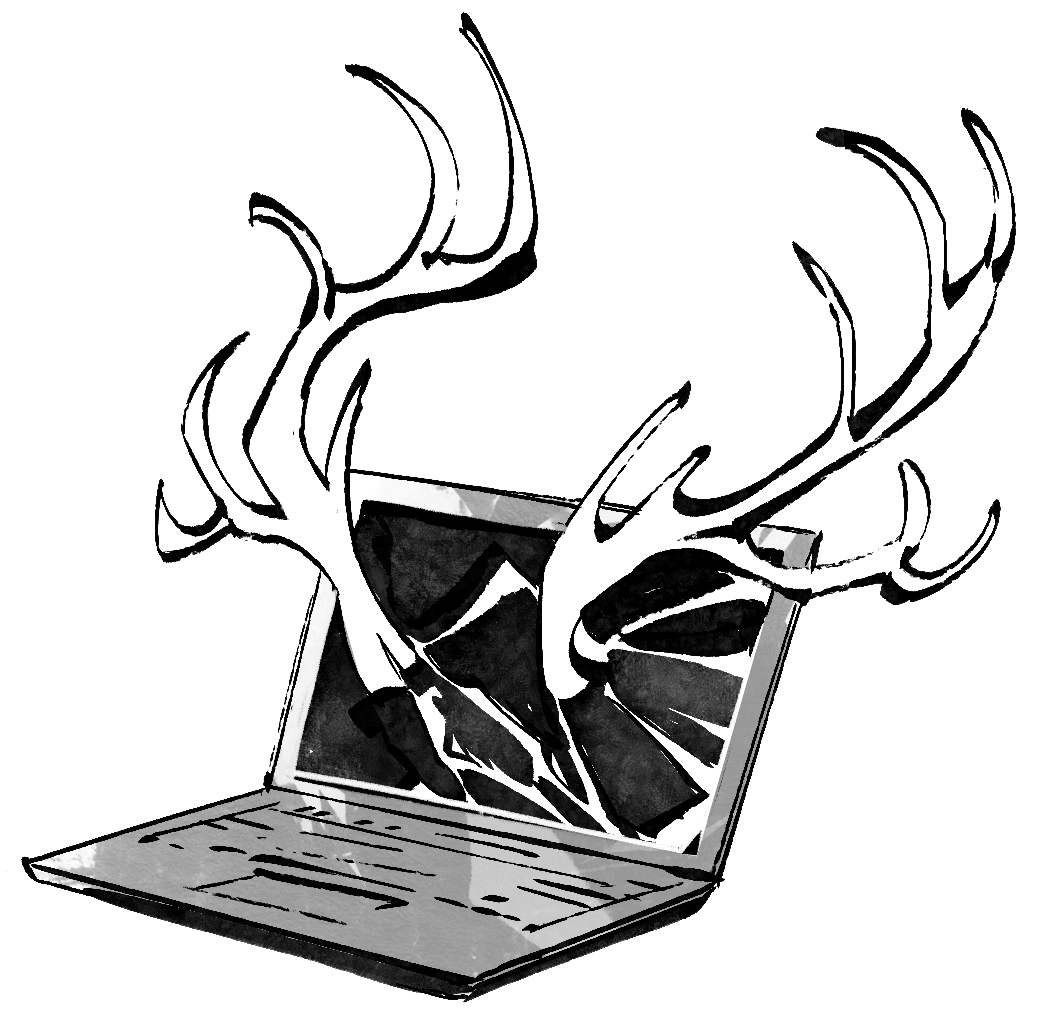
He was hunkered down under the table, antlers lowered in the tight space, the laptop warming his legs as he followed the news. He sometimes snuck a glance at the does from beneath the tablecloth; human-digited feet and linoleum-tapping hooves flitted past him. We go, we go, they murmured, picking out the artificial skins, detergent-scented skirts and pineapple-print shirts, that would leave their stomachs covered in rashes by the evening. Gamboling about, clinging to one another, they got dressed. One of them—Réka?—was trying to pull a sweatshirt on over her legs. Another—Virág?—had her shoes on the wrong feet.
. . . come with us . . .
. . . we go to the tourists . . .
It was Jolán’s idea, like always, and within minutes it had infected the others. It was also trying to take root in Kirill’s mind. Eyes closed, he concentrated on blocking out Jolán’s thoughts, on stopping the proliferation of weeds before it started.
. . . we can only go together . . .
. . . it’s time, Kirill, don’t hide . . .
All at once, they were surrounding the table. They peeked in at him under the tablecloth, some of them crouching like sapiens, others on all fours like deer. Their eyes shone brown, rich as chestnut. Despite the smell of detergent on their clothes, Kirill could still breathe the greenscent of the herd.
. . . caressing that machine of yours again?
. . . why don’t you nestle with us?
“I’m reading the news,” he explained. “There’s a creation. They’re finding cocoons everywhere: Japan, Australia, Canada, India. The Russians have declared a state of terror.”
The does cocked their heads, stared at him as if they didn’t understand a word he was saying. It was the same glassy-eyed stare they got whenever he talked to them about his blog, or when he read them his fables.
“Should I explain?” he asked. “I’ll show you a photo, just . . .”
He tapped the artificial finger wedged into his hoof at the keyboard and brought up a news site. The first domestic cocoon had appeared at a family house in Gödöllő; it was a parrot who no longer squawked for the proffered biscuit in its owner’s hand. Animals, tens of thousands of them, lifted their heads like they’d been called, a divine summons, it drove them mad in an instant, they threw themselves to the ground, writhing as they tried to shed themselves of the skins that itched them. And shed they did. Within hours, they’d cocooned up, only to emerge the next day as part-human, part-animal freaks. Cows, dogs, crows. Mostly vertebrates, but there were always one or two clams or June bugs, even if the creation proved lethal for them.
The does stretched their necks, leaned in closer. Kirill turned the screen to them.
“You see? We’re not dying out. There might even be more deer. This is more important than the tourists, they’ll be celebrating all over the world, the new cocoons and the—”
Virág lunged forward. She stooped underneath the table—her deer ears catching on the stained tablecloth—and snapped the laptop shut as if she were slamming a door. She tried to wrench it from Kirill’s lap, but he gripped it tight.
“Hey, what the fuck?!”
. . . do you not love us anymore?
. . . you pet your clicking-machine instead of us . . .
. . . you’ve caught sapien frenzy, Kirill . . .
He was trapped under the table. The herd all pounced at once: Tamara pried his arms apart, Réka snatched at him from the left, Sára gripped his ankle. Silken deer fur swirled around him.
. . . sapien frenzy, sapien frenzy, we’ll cure you . . .
He wanted to shake them off, but the space was narrow, his antlers clattered against the table. At other times the does would nestle against his neck, imploring, snuffling and nuzzling under his arms. But this time Virág used her fully metamorphosed, yellowing human teeth to bite into his ear.
Kirill cried out. He knew they would win. He stood no chance against all eight.
He closed his eyes and envisioned. A deer rushing through the thickets, froth speckled down its back. Veins swelled on its neck, its pupils stretched wide. A wolf is close on its trail, thundering ever closer in the brush. Its jaws open wide with meat stench, it sinks its teeth into its prey’s thigh . . .
. . . predator!
. . . predator!
The does relinquished their hold on him. They kicked out in fear, as if the wolf were really there chasing them, they bounded here and there looking for escape. Like Morse code, their heels tapped out the alarm signal.
“Stop it!” Jolán shouted. She wasn’t so easily duped by such a trick. “There is no predator, you do not need to sound the alarm. What is wrong with you, Kirill?”
Clutching his laptop to his chest, he escaped from under the table.
“I was trying to explain! After a six-month dry spell, there’s finally another creation—”
“Quiet!” Jolán roared, then cleared her throat as if she were coughing up phlegm. It had been days since she’d used human speech. “We do not care why you caress that stupid machine so.”
“It’s a day of creation! We can go see the tourists tomorrow, but today . . . Maybe some deer metamorphosed! Don’t you want to grow the herd? Don’t you want fawns?”
Jolán snorted, scratching her elbows where the human skin and the deer hide ran together. Kirill was sure she would understand. He’d tried so many times to explain, but this time she’ll get it, his joy would seep into Jolán’s mind and she would realize how important today was. After half a year!
The doe considered. Her ears twitched, as if whisking away a fly. Finally she spoke.
“You have sapien frenzy, this is the problem. They have infected you.”
“What?! I was talking about the creation! And I don’t have sapien frenzy, let’s not start with that, ’kay?”
“‘’kay?’ You even talk like them.” Jolán pulled back her lips, flashed her gums. “You think you are the only one who hates the tourists? You think we like wearing false skins, like them pawing at us? They reek, yes. They are fat, they stuff themselves with meat, they have forgotten the greenscent. But we need money, we need their sapienpaper, otherwise we will never get to go home. The herd survives . . .”
“Jolán, don’t!”
“. . . the lone deer dies.”
Kirill shook his head in dismay. If eight wanted the same thing, the ninth could not deny them.
“You have not forgotten the greenscent, have you? You do remember it?”
He could feel Jolán’s intention, and he wanted to run but the doe was quicker. She was on him, neck nuzzling against neck. Body on body, skin on skin. The others gathered around them, caressed them, delicate as petals. Three-fingered palms intertwined with hooves, fingers without nails wove into cinnamon-brown fur, a human-deer mosaic.
. . . greenscent, greenscent . . .
Jolán was thinking of the forest. Kirill saw the hollow oak before him, the bark ripe for scraping his antlers into, the molten gold light dripping through the lace of canopy. As Jolán swallowed, the taste of elderberry coated their tongues. The dandelion-scented breeze on their fur, the smell of the clearing, sharpened blades of grass and dew-dripped alfalfa tickling at their breasts.
Nine minds melted into one. Nine hearts beat in sync, nine stomachs churned in rhythm, intestines wound into a singular helix. They could feel each other’s trembling muscles, the itching patch on one of their shoulders, all of their shoulders, the split nail on one of their fingers, all of their fingers, the communal warmth of the communal herd, the perfect togetherness.
Leave. Jolán thought it, and they stepped in rhythm out into the stairwell.
• • •
Jolán claimed that every time they ventured out from their home, the sapiens’ city broke into their lives. Glass-eyed concrete blocks towered overhead, rigid in iron and aluminum, silent monoliths whose eyes scintillated from ruler-etched angles. Everything was dead. Everything they bit into they spit out snorting—plaster, they’d learned the word from the social workers, do not taste. Even the rain water running down their noses tasted of tar. Tamara was unable to leave the asphalt alone, her scrabbling had her nails constantly covered in blood-soaked wrappings.
. . . strength in the herd . . .
. . . the lone deer dies . . .
But more dangerous than the city were the people. Safari buses unending arrived from Budapest, and on weekends the commuter rail was packed to capacity, disgorging its passengers at the Kistarcsa stop from where they continued on foot to the socialization center. They rarely traveled alone, there were usually a handful of umbrella-wielding sapiens directing the herds, making sure no one wandered astray. The does used to think that rectangular boxes grew on their faces; all of them held tight to their phones, they wanted to photograph everything.
A song bird sings arias by the fountain, coins tinkling in its plastic cup. Click.
An overalled goatman rides a bicycle, horns covered in foam packing as per regulation. Click.
A family buys cotton candy from a waist-high mousegirl. Click.
Rhinestoned duck beaks and tattooed hooves, three-fingered hands and tufts styled and curled. Click-click-click. The tourists wanted selfies with everyone. They beamed in the photos, flashing all of their teeth just like a predator. They trailed chemical clouds of perfume and creams that left the herd sniffling and sneezing. They pounced on the souvenir counters like scavengers, trying on raven masks and rabbit ears, threading plush fox tails through their belts. Or sometimes if they wanted a more unique memento, they would pry off and steal a DO NOT FEED THE BREEDS! signs.
Few took the rules about feeding seriously. The tourists tempted them with crackers, they wanted photos of the does eating out of their hands, but Jolán forbade them from accepting so much as a celery stick. Last year an old woman had distributed sixty poisoned muffins. Sometimes sandwiches laced with glass shards showed up. Even so, there were many who thumbed their noses at the danger and stared drooling at the families chomping through hot dogs, hoping to beg a morsel off them.
“Daddy, Daddy, look! They have Bambis!” a little boy squealed from beside the chimney cake stand, tugging at his father’s coat sleeve. “Can I pet them Daddy? Pretty, pretty please!”
Smile, thought the herd, and up flashed nine smiles. They preferred lovebird couples, lipstick-stained kisses could be washed from fur, whereas stoned university students would tug at Kirill’s antlers like he was the trophy from their big game hunt. Things went more smoothly with children. They were weak little creatures: a fawn took its first faltering steps immediately after birth, while these stomped about in a rage if they got raspberry ice cream instead of vanilla.
“Hello!” The herd turned in unison to the little boy. Nine pairs of batted eyes, nine mouths moving as one. “Would you like a group photo?”
“Can I? Can I, Daddy?”
“Deer are lame, Tomi,” his older sister huffed. Her souvenir wolf mask was pulled up on her forehead as she tapped away listlessly at her phone. “Why don’t we go see the lion? The line’s shorter now.”
“The lion stinks! And its claws are plastic, I saw!” The boy tugged at his father’s hand. “Daddy, please! I want the Bambis!”
“Alright, alright, that’s enough.” He rummaged for money in his wallet, in skin worn by a calf not long ago. “Stand over there, come on, you too, Marietta. You can get cotton candy after.”
The little boy shoved in among them, threaded one of his mitts into Virág’s hand, took Réka’s hoof with the other. He grinned, the gaps from missing baby teeth clear to see. His sister sidled up to the edge of the herd. She pulled her wolf mask from her forehead to her face, only her eyes glinting above the plastic jaws.
. . . Kirill . . .
. . . Kirill . . .
The herd fractured. Their movements were no longer synchronized: Tamara looked out for predators, Jolán handled the payment, the others donned the smiles they’d perfected before a mirror. Nine bodies, nine wills. Kirill had just been viewing the square through nine sets of eyes, from the fountain to the safari buses. He’d listened through nine pairs of ears, nine synchronized heartbeats had resounded within him. But now he was alone.
“Fuck,” he wheezed, leaning forward as he gasped for air.
The does didn’t feel the change, while he staggered in his dizziness. Cheeeese, the father called out behind him, and Kirill realized where he was. Hadn’t he just been hunched over his laptop? The does had infected his mind, forced him to go with them, but before this he’d been reading the news, important news . . .
The creation. After a half-year drought, breeds were again awakening in every corner of the world. Cocooning chickens and cows were being found everywhere, the breed complaint hotline was sure to be overwhelmed.
“The breeds awake, our rights we take!”
The chant might have been sounding this entire time, but Kirill only now heard it. A crowd at least one hundred strong had gathered before the socialization center. Their celebration was unbridled, feathers shaking as befit a day of creation. They beat emptied cans of food, clinking forks served as music. Waist-high mousebreeds linked together in a circle dance, a pigeon twirled, the sparklers in its hands sending shooting stars of gold every which way.
“The breeds awake!” A catgirl sat atop another breed’s shoulders, sprinkling confetti everywhere. “Up yours, sapiens!”
They called themselves the Flock. Kirill had seen their tags in the ghetto, a spray-painted, even-toed hoof. They also wore the insignia on their arms, tattooed onto shaved skin.
He shouldn’t have let himself wander over. It was the greenscent of the herd he wore, not that hoof tattoo, and besides: the lone deer dies. But he couldn’t repress his curiosity. They understood what it meant to have a creation after a half-year drought. They were celebrating.
“Want some?” A birdbreed who barely reached Kirill’s chest ambled over. A sickening smell of fermentation poured from the orange juice bottle he offered. “You been staring at us a good minute.”
“You’re the Flock, right?”
“So you have heard of us,” the bird grumbled. He might have been some type of finch, he had a shock of orange feathers either side of his face like fever spots. “Didn’t figure anyone chumming about with sapiens would give two shits about the Flock.”
“I’ve been looking for you.” Kirill had once stood outside a house with the hoof sign on it for hours on the off chance of meeting with one of them. He wanted to write their fables: Story of the flock that didn’t fear the wolf. “I’d like to speak with you.”
“Today we’re celebrating, not chitchatting. Have a drink, go on then!”
He shouldn’t have. The does would immediately feel the alcohol, it would nip at all nine of them all at once. Kirill shrugged, using his teeth to pull a straw from his shirt pocket and lower it into the bottle. Just one sip had his throat on fire, like he’d swallowed hot coals, like something was alive and dancing down his esophagus. Sapien fever.
“That’s it!” The finch clapped him on the shoulder. The chemical scent of humans hung about him, a mix of deodorant and mint toothpaste. “Six long months, can you believe it? The Black Sheep promised it would happen!”
Kirill nodded, his eyes smarting from the drink. The revelers were howling around him, a crane danced about, wings furling and unfurling like a broken umbrella. It was the first time in weeks Kirill had gone anywhere without the permission of the does. Jolán sent them out to request donations in groups of three; in chorus they asked for cabbage, stealing the words right out the others’ mouths.
The little boy who wanted the photo was perched on Virág’s neck, kicking his sneakers against her chest. His sister’s boredom seemed to have gotten worse, because she’d taken the gum she’d been chewing from her mouth and pressed into one of the doe’s fur. They’d have to cut it out later that night.
“Dunno why you let them do it,” the finch remarked, taking a swig from the bottle. He was drunk, the skin around his nose was flushed. He could have been subjected to a socialization inquiry for breaching the law against alcohol consumption. “No breed should sink that low, rubbing up against the tourists’ legs like some lapdog.”
“This is temporary,” Kirill explained. “We only come out when we have to.”
“Ha, temporary, sure!” He gave a chirping laugh, what remained of his beak flapping above his mouth. “Always the same excuse. If you behave like an animal, don’t be surprised when the sapiens treat you like animals and let you lick pudding from their fingers. You should come see the Black Sheep. He’d help you with those damned remnants.”
Kirill tore his gaze from the does, his attention back on the Flock. They shrieked and warbled, blew full blast into plastic horns.
“I can meet the Sheep?” he asked. He hoped his voice didn’t betray his eagerness. “You can set up an interview?”
The finch cheeped as he looked him over.
“You fancy yourself some kind of journalist or something?”
“I’m a blogger. I collect stories of breeds, their fables, and I—”
“I’ll tell you what you are.” He jabbed a finger behind Kirill to where the tourists, change jingling, wandered among the breeds, arm-in-arm photos being snapped. “A beggar and a pet. Look how desperate you all are for attention! You cute breeds have a chance, baby deer always make for a good photo, not like the rats and the snakes who have to grind away in the factories.”
“I don’t beg.”
“That so? And what would begging look like to you exactly? Using your tongue to lick their boots clean and your fur to polish ’em up real nice?”
Kirill tried to pull away, but the finch gripped his arm, and with far more strength than his paltry bird muscles would have suggested. He didn’t even reach Kirill’s shoulder, and had to stand on tiptoe to look him in the eye.
“It’s beneath you,” he said. “It’s beneath all of us.”
Kirill wrenched free of his grasp and backed away. Maybe he’d been wrong about the Flock. He’d heard so many rumors about them, how you change when you join them, become stronger, braver. That’s why he’d wanted to write their story, but all he saw now was a ragged group of drunken, belligerent breeds.
“You really interested in the Sheep?” the finch called after him. He flashed his forearm: it was marked with the same even-toed hoof that was tagged on houses. Kirill had always assumed they were tattoos, but they were brands. Burned into skin with sizzling iron. “Whenever you’re sick of begging, go to the sanctum. Tell them Martin sent you, they’ll let you in.”
“And I can talk to him?”
“If you’re worthy.” Martin shrugged. “Oh, and make sure you come alone. You come with your harem, you stay outside.”
He raised the orange juice bottle like he was preparing a toast, then started moving his hips to the rhythm of the ringing forks and cans. He was absorbed into the crowd. Kirill could still make out the tuft of feathers bristling atop his head like a signal buoy before he vanished among the breeds.
An invitation from the Flock. Jolán would be furious; the does never understood why he collected the stories of breeds. They would have been frightened by the crowd, predators and prey dancing within biting distance, where an artery could be torn through in the blink of an eye. They would say that the Flock sweats meat stench, fatty sausage hangs on their breath. That’s not fitting for deer.
But still, Kirill wanted to get to know them.
“I found him!” the little boy squealed behind him, grabbing his hoof. “I found the Bambi with the antlers! I can sit on your shoulders, right? Come on, come on!”
The brat jumped on him from behind, just like a predator would, and clung tight to his waist.
“Pick me up!”
“Wait, wait, I . . .” Kirill scanned the crowd, but he didn’t see the finch named Martin anywhere. “I’m not doing photos today, sorry. I’ve got things to do.”
He tried to break out of the embrace, and the boy’s mouth began to tremble. He’d soon be bawling. Crying children were bad for business: no parent wanted to show off a photo of a wailing child.
“Some other time, I promise, just let go. Let go of me already!”
The little boy’s fingers clamped down on his skin like clothespins.
“But I want to see the antlers! Let me see, let me see!”
The herd whispered in his head—let him, Kirill, what’s the matter?—but he didn’t budge an inch. He should have just bent down so one of the does could place the boy on his shoulders, clutching his antlers and finally getting his stupid photo.
“It’s not fair!” the little boy cried. “Stupid Bambi!”
“And now he’s crying, Dad, didn’t I say?” The boy’s sister was still wearing her wolf mask as she walked over with their father. “I said we should just go, we’ve already seen these dumb animals at the zoo.”
“Sweetie, we talked about this,” the father rebuked her. “We don’t call them animals. And don’t cry, Tomi, he’ll pick you up now. The little deer was just waiting for Daddy.”
The girl sighed and pulled up her mask.
“Why not? They’re a bunch of stupid furry mutts surrounded by walls and begging for food. Seems close enough to me. Animal, animal, animal! See? They don’t even care.”
“Daddy, I want to sit on the Bambi’s shoulders!” The little boy pulled at Kirill’s fur. “Hurry up!”
“I’m asking both of you to behave, otherwise we’ll never—”
“Pick me up, pick me up!”
“The one with the antlers doesn’t even have fingers!” The girl laughed. “It couldn’t wipe its own ass with that hook stuck into its hoof! He should just be happy he didn’t end up on someone’s dinner table.”
“Marietta, that’s enough! Apologize to the breeds this instant.”
“Or what, are they going to bite me? They even try it and it’s straight to the meat grinder.”
Kirill bellowed. He jerked away, and the boy let go in his panic and fell to the ground. He didn’t think, just threw his head back, antlers stabbing toward the sky. They were sharp as knives, branching like a pitchfork. It was like he’d grown a full head taller, he squared his shoulders, the deer muscles of his chest bulging. He’d never dared to fight back. Not even after dark, when drunken groups ordered him onto all fours to snap photos of them standing behind him and gyrating their hips. The shushing of the does always sounded within him—nothing happened, let it go—like an inflamed splinter he couldn’t pull out.
But now he couldn’t keep calm. It’s beneath all of us. Maybe he’d forget them by tomorrow, but for now, the finch’s words were still fresh: he couldn’t bring himself to stand before the camera with a snotty little brat hanging on his neck, not for one single snapshot.
“Hey, hey, calm down!” Their father stepped in between them, shepherding his children behind him. “Have you lost your mind? You’re scaring my kids to death!”
“Don’t touch me.”
“You said we could take photos with you! That’s what we paid for, and you think you can send my son flying like that?”
“I said I’m not doing photos today, not with anyone.”
“They’re kids! Deer are supposed to be docile. You can’t go and throw a four-year-old to the ground!”
“Today is a day of creation.” Kirill grinned, pointing to the celebration behind him. The girl, face drained of color, peeked out from behind her father. “More and more animals are going to be running around everywhere, so it’s time you all got used to it.”
The girl trembled. The vein on her neck danced, twitching like a captured fish. The skin over top of it was thin as rice paper, thin enough that a feather could pierce it.
“Alright, that’s enough,” the father roared. “Startling children, you ought to be ashamed of yourself. It’s the taxpayer’s dollar that pays for your vaccines, gives you something to eat, and for all that you’re not able to make a little boy happy for two minutes by smiling for a damn photo . . .”
The man kept talking, but Kirill was no longer paying attention.
. . . what are you doing, Kirill?
. . . calm, calm . . .
. . . why do you grin?
He didn’t want to be touched. Didn’t want his fur pulled, didn’t want gum pressed into his hide. The does intervened, the eight of them bounded over to the father, begged his forgiveness with submissive affability. Their anguished smiles looked like they’d been painted on. Jolán cast a glance at Kirill—her normally warm chestnut eyes smoldered—but Kirill just shook his head and began backing away toward the edge of the square.
“It’s beneath you,” he said.
He turned and rushed across the square, away from the herd.
• • •